Argus (2026)
After every single safety meeting, even if something happened, it would be the same things like wear your PPE, and nothing actually useful came out. That stuck with me over the summer as a project coordinator.
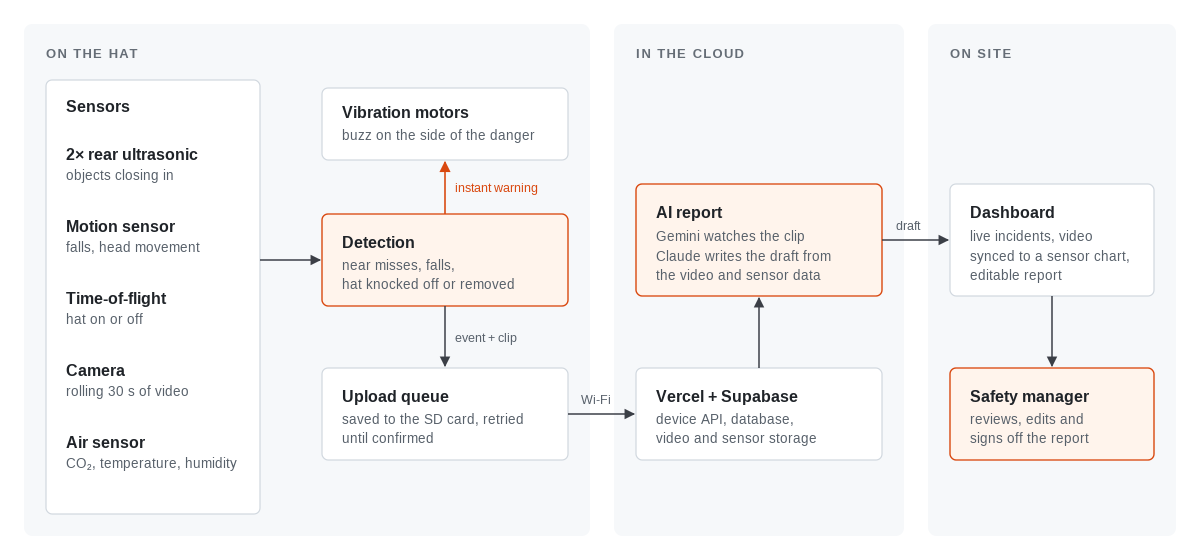
So at natHacks 2026, six of us spent 64 hours building Argus: a retrofit kit for a normal hard hat that watches behind you, buzzes on a close call or a fall, and drafts a safety report for a manager to review. The report is the product. The hat is just how you collect the data. The name is not really that symbolic, just kinda stupid. I had just come out of watching the Odyssey twice, so I named it after Odysseus’s dog and a cyclops in Greek mythology.
What I did
I worked on the hardware, how it all integrated, and how we recorded data from it. I broke that into fall detection and “an object is moving towards you” (it first started as just behind you) and got that to buzz. I figured JSON would be the best way to transmit all the data. I also figured out how to get it over Wi-Fi the best way possible, and how to send a dashcam-like video over the internet so the main dashboard can look at it and make it look pretty.
One of the first solders I did, before the perfboard stuff, was just the headers onto the IMU. My solder was so bad that I had to redo it, and Dhir and Shreay had to do the ones that were really bad. Even though most of the diagrams for the perfboarding were done by Hari and Shreay, I alternated between that and the software for the sensors. On the board itself we ran two I2C buses. Bus 0 carries the IMU and crown ToF. Bus 1 carries both DRV2605L drivers and the SCD41. The ultrasonics stayed on GPIO for trig and echo. Mid-weekend we swapped off L293D motor drivers on GPIO for DRV2605L boards, so the haptic path had to move onto SDA/SCL on bus 1.
How it works
For struck-by, each rear ultrasonic keeps a short range track. Closing speed is the slope of range vs time, then ego-motion from the IMU gets subtracted so walking backward into a wall does not look like a charge. If it confirms twice under 2 m, closing faster than 1.5 m/s, TTC under 1.3 s, and the hat is on, that side buzzes.
Fall detection took longer. After many falls from Okitha and Dhir, squats from Shreay, and many injuries later, we finally landed on a pure IMU magnitude state machine. Every sample computes mag in g:
mag = √(ax² + ay² +
              az²)
A fall only fires if there is freefall first: mag under 0.35 g for a continuous run of at least 200 ms (gaps longer than 15 ms start a new run), then a landing of mag at least 3.0 g within 1.0 s after that freefall ends.
The event emits when the pulse ends, not at the first spike: either mag stays under 3.0 g for 30 ms, or the pulse has lasted 500 ms, then 300 ms of debounce. If there is no freefall but mag hits 6.0 g or more, that is a head impact, not a fall. Whether the hat is on is a separate ToF check, not part of this detector.
Once something serious fires, the Pi cuts a clip, bags the sensor trace, and queues an upload over Wi-Fi so the dashboard can show the dashcam-like video and the draft report. The hat sets the class. The LLM never does.
Hard parts
The worst moment was when I could not get the fall logic down. The IMU would constantly trigger randomly and spit out values like 29 g, and the I2C bus would fail so the IMU was no longer being measured. We switched to a new IMU, the Pololu MinIMU on the hat now, and that was much better. Then we fine-tuned the fall logic so false falls are not recorded and real falls do not go unrecorded.
I had never worked with a Pi on WPA2/WPA3 Wi-Fi before, the kind with both a username and a password. Doing that on my friend’s Pi, one that was not really flashed yet, was really annoying. The wiring also kept failing because one of the 5 V pins was not actually supplying power. Other than that, everything was working.
The good moments stuck too: when the buzzers finally worked, when the IMU actually detected falls, when the hardware team’s software integrated with the software team’s software, and when all the stuff worked during the pitch.
What I learned
I learned how to breadboard effectively when I was not given instructions like in labs. I got better at reading outputs from different sensors, and how I2C works in more depth. I learned how to transmit data over Wi-Fi efficiently, how to use Pi cameras, a variety of sensors, and the Pi itself more in depth. I also learned how to use an Arduino Uno R3 for testing (it was not actually used on Argus), and how to actually pitch during a hackathon and what they look for.
I left a little disappointed, but glad we built something real under that time crunch, and already thinking about the next one.
Ways to improve
If I had to tell myself one thing before the next build: run through the hardware way quicker and concentrate way more on the pitch. Learn how the business side works and how to market that in a short pitch. Identify the target audience, have a clearer business model, and show that spending money on safety is not only better for people but also makes sense monetarily, since this kind of hackathon is meant to make money for the investors. The wiring was my first time, so it is okay that it was slow, but I should be quicker going into the future.
Code and docs are on GitHub.